
LTL shipping is ideal for businesses that need to ship freight on a regular basis but do not have enough to fill an entire truck. This shipping method is one of the most cost-effective solutions available. LTL freight shipping is used by growing e-commerce businesses, small to mid size manufacturers, and distributors.
At Terralink Logistics, we work with businesses every day that require LTL freight shipping. We help these businesses by helping them cut costs, improve delivery reliability, and scale their logistics operations. In this guide, we’ll break down the top benefits of LTL freight shipping and share actionable strategies you can use right now to lower your LTL rates
What Is LTL Freight Shipping?
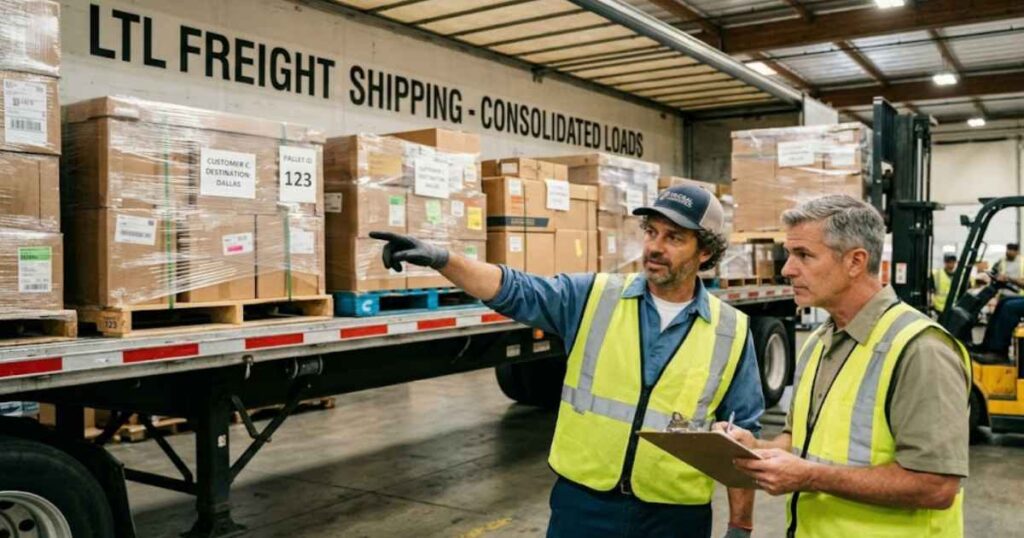
Less-Than-Truckload (LTL) freight is a shipping method where multiple shippers share the space on a truck. For businesses that ship smaller quantities, this method works better than booking an entire trailer. In LTL freight shipping, your cargo is consolidated with cargo that is going to the same destination. Businesses pay for the space your cargo occupies within the truck. LTL Freight shipping is ideal for shipments that weigh between 150-15,000 pounds which is too heavy for parcel services and not enough cargo to load a full truckload.
How LTL Rates Are Determined
LTL Freight is determined by freight class, weight, distance, fuel surcharge, and accessorial fees. Understanding how LTL rates are determined is key as it will help carriers understand how much space your freight will take up and if your freight is difficult to ship safely.
- Freight Class – National Motor Freight Transportation Association (NMFTA) sets the freight classes also known as codes which are industry standard for LTL shipping. NMFTA considers the following when determining freight class: Density, Stowability, Handling, Liability. Classes range from 50 to 500, lower the class means your product is easier to ship (lower cost) and higher class means your product is lightweight (higher cost).
- Weight – LTL rates are based on CWT, hundredweight, which refers to a rate per 100 lbs. Most carriers use a tier based pricing structure where the cost per the hundredweight decreases as the total weight increases.
- Distance – The farther your freight travels from pick up to delivery location, the higher the cost. Selecting the correct carrier (regional vs national) is important if you are shipping regional.
- Fuel Surcharge – This fee is usually updated on a weekly basis based on national diesel fuel averages and is calculated as a percentage of the base freight.
- Other accessorial – these are additional services that your freight may require. Normal fees include dock to dock rates but if you need lift gate , residential delivery, and/or inside delivery.
Key Benefits of LTL Freight Shipping
LTL shipping offers many advantages which makes it an ideal choice for businesses of all sizes. Below that make it a preferred choice for businesses of all sizes. Here’s why more shippers are choosing LTL:
| Cost Savings LTL shipping allows you to pay for the space that is used by your cargo. This helps businesses avoid the high shipping cost of using a full truckload when they do not require it. | Shipping Flexibility LTL allows businesses to ship smaller quantities rather than waiting and shipping a full truckload. This helps keep your supply chain moving along. | Sustainability LTL reduces the number of trucks on the road by consolidating the goods into one truck for multiple shippers. This helps lower the fuel consumption and carbon emissions. |
| Protection LTL shipping is usually shipped in secure pallets which reduce the risk of damage compared to small parcel shipping. | Enhanced Shipment Visibility Most LTL carriers use real time tracking tools and updates, giving businesses full visibility into where the freight is and the ETA. | Accessorial Service Options LTL freight shipping offers many options as add on such as lift gate service, residential delivery, inside delivery which makes it easier for handling. |
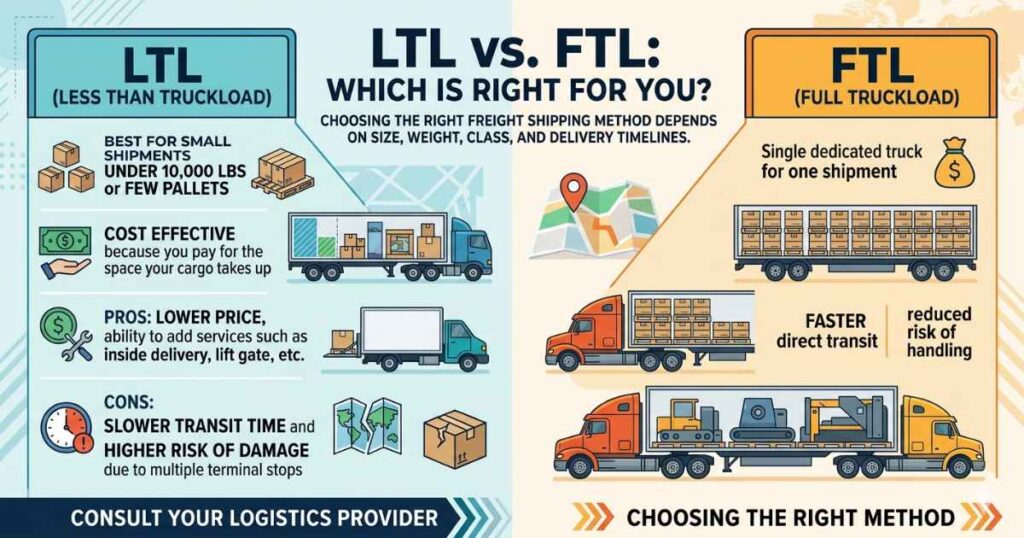
LTL vs. FTL: Which Is Right for You?
Choosing the right freight shipping method depends on size, weight, class, and delivery timelines.
LTL (Less Than Truckload)
- Best for small shipments that under 10,000 LBS or new pallets.
- Cost effective because you pay for the space your cargo takes up.
- Pros: lower price, ability to add services such as inside delivery, lift gate, etc.
- Cons: Slower transit time and higher risk of damage due to multiple terminal stops
FTL (Full Truckload)
- Best for shipments that are over 10,000 LBS and usually require a full truckload of space.
- FTL is higher cost but lower per pound rate for dense cargo.
- Pros: Faster transit time (Direct shipping) and reduced damage risk due to reduced handling.
- Cons: It could be expensive if you cannot fill the full trailer and less flexibility on delivery scheduling.
Why Partner With Terralink Logistics
At Terralink Logistics, we focus on more than just transportation. We work with our customers to create efficient, strategic solutions that keep our customers freight moving along. Here’s what makes us different:
- Carrier Network: Our access to our large, vetted LTL carrier allows us to give you the best price with the most reliable carrier.
- Rate Negotiation: Our volume and relationship with our carriers helps us negotiate competitive rates that other shippers simply cannot achieve on their own.
- Freight Classification Expertise: Our team expert helps you classify your freight accurately so you do not get penalized with higher cost due to misclassification.
- End-to-End Visibility: Our team experts provide you with tracking updates so you are informed throughout the journey of your freight.
- Dedicated Support: We are individuals who help you from the quoting process to delivery and all questions in between.